Lumbar spine pain: When the back takes over
Although the human brain only makes up around 2% of our body weight, it uses around 20% of the energy. Crazy, right? Our head thinks a lot and often forgets the rest of the body. Especially the lower back. Only when pain occurs there do we realize how dependent we are on a healthy center. Welcome to a problem that affects millions: lumbar spine (lumbar spine) pain. Reading tip to get you started: From head to toe – this is how our body regions are connected What is the lumbar spine and why does it often cause problems? The...


Although the human brain only makes up around 2% of our body weight, it uses around 20% of the energy. Crazy, right? Our head thinks a lot and often forgets the rest of the body. Especially the lower back. Only when pain occurs there do we realize how dependent we are on a healthy center. Welcome to a problem that affects millions: lumbar spine (lumbar spine) pain.
Reading tip to get you started: From head to toe – this is how our body regions are connected
What is the lumbar spine and why does it often cause problems?
The Lumbar spine, medically as Pars lumbalis columnae vertebralis called, forms the lowest third of our spine. It consists of five strongly pronounced vertebrae - named as L1 to L5 – and, from an anatomical point of view, lies between the one above it Thoracic spine (BWS) and that Sacrum.
Their central task is to create the connection between the upper body and pelvis. It takes on an enormous amount of work: it carries the majority of the body's weight, acts as a shock absorber with every movement and at the same time enables a high degree of mobility - be it when turning, bending, standing up or walking.
The special thing about the lumbar spine is its S-shaped curvature to the front, the so-called Lumbar lordosis. This curvature is not a bad posture, but rather an evolutionarily developed adaptation to the upright walk of humans. It ensures that loads are distributed evenly across the vertebrae and intervertebral discs. However, this also means: If this fine biomechanical system is disturbed, for example due to muscular imbalances, one-sided strain or lack of exercise, the entire statics of the back become unbalanced.
Another important aspect is that Nerve supply: Several large nerve cords emerge from the spinal cord at the level of the lumbar spine, including the Sciatic nerve. These nerves supply the muscles and skin of the legs, pelvis, and lower back. Even a slight irritation, for example from tense muscles or a herniated disc, can lead to radiating pain, numbness or discomfort.
The lumbar spine is not just a supporting element, but a complex interaction Bones, joints, muscles, intervertebral discs and nerve structures. And it is precisely this interaction that makes them so sensitive. Even seemingly harmless everyday habits such as sitting rigidly at a desk for a long time, a poorly fitted mattress or constant lifting with a rounded back can lead to problems Incorrect loads which manifest itself in the long term in the form of pain or restricted movement.
What's particularly tricky is that many stresses build up gradually. First it hurts when you get up in the morning, then when you bend down or drive. And before you know it, a small imbalance has turned into tangible pain. Sometimes acute, sometimes chronic. The good news: Most lumbar spine complaints can be recognized early, understood and alleviated or even completely avoided through targeted measures.
Why does the lumbar spine often cause problems?
The lumbar spine is exposed to a variety of stresses in our everyday lives. Far more than we often realize. Their main function as Support and movement center involves constant strain: it has to support the weight of the upper body, support every movement and at the same time balance shocks and rotations. Biomechanically, this makes them particularly susceptible to overload and wear.
A central problem of today is this modern lifestyle, which in many cases is characterized by too little movement, predominantly sedentary activities and one-sided postures. For example, anyone who spends many hours in front of the computer every day often does so with a rounded back, head stretched forward and little trunk activity. This results in the finely tuned Muscles around the lumbar spine are out of balance: While some muscles are overloaded and permanently tense, others atrophy due to lack of use. This imbalance can lead to tension, poor posture and ultimately painful reactions after just a few weeks.
In addition, the Intervertebral discs, which lie like elastic shock absorbers between the vertebrae, are not optimally supplied with nutrients when sitting for long periods of time or under one-sided strain. you need Movement and pressure changesto regenerate. If this supply is lacking, they lose elasticity. As a result, the risk of herniated discs or degenerative changes such as these increases lumbar spinal canal stenosis.
Also psychological factors such as stress, constant tension or emotional strain play a major role. Studies show that chronic stress not only affects the cardiovascular system or sleep, but also the muscle tension in the back, especially in the lumbar area. Many people “process” psychological tension through their bodies. The muscles harden, blood circulation becomes poorer, pain increases, and a vicious circle begins.
Last but not least, wear too individual physical requirements, such as anatomical misalignments, leg length differences, obesity or hormonal changes, contribute to the fact that the lumbar spine often causes problems. Especially in older people, natural wear processes occur that further reduce the resilience of the lumbar spine.
In summary, it can be said: The lumbar spine is a highly complex, resilient, but also sensitive system. It is at the center of our everyday movement and is at the same time a reflection of our lifestyle. Those who suffer from constant pain often have pain that is not just physical, but pain multifactorial problem to do. This makes it all the more important to take a closer look and take action early on.
According to the Techniker Krankenkasse, this applies in particular Sitting, lack of exercise, obesity and psychological stress as the main driver of chronic back problems【9】.
When the back speaks: Typical symptoms of problems with the lumbar spine
We often only notice how much strain our backs are under when the symptoms become clearly noticeable. Outwardly the position may still seem stable, but the lumbar spine sends signals early, which we all too easily ignore: a pulling sensation when standing up, a feeling of tension after sitting, a slight burning sensation after lifting a shopping bag.
Initially, symptoms in the lumbar spine area are typical diffuse, dull or pulling pain in the lower back. These usually occur over the course of several days or weeks, often without a sudden event. The pain is deep - often directly above the sacrum - and can be located either in the middle or slightly to the side. Many sufferers describe the feeling as if their back was “stiff” or “blocked”, especially in the morning after getting up or after sitting for a long time.
As the disease progresses, the pain may worsen. One is particularly common Radiation into the buttocks, hips or even the legs. In this case, doctors speak of Sciatica syndrome, in which the sciatic nerve is irritated or pressed, for example by tense muscles or a bulging disc. This is manifested by pulling, sometimes burning pain along the back of the leg, accompanied by tingling or numbness.
In addition to the actual pain, it often occurs secondary symptoms on: The muscles in the lower back tense reflexively, which further limits mobility. Even simple movements such as bending over, turning over in bed or climbing stairs become a challenge. Many report that they feel “old” or “stiff as a board” even though they actually consider themselves fit.
It is also noticeable that Psychological tension can worsen the symptoms. Anyone who is under pressure in everyday life, hardly moves and doesn't take conscious breaks often experiences an increase in symptoms, especially at the end of a stressful day.
In more severe cases - such as herniated discs - it can also occur neurological deficits come. These include sensory disturbances (tingling, numbness), muscle weakness or problems walking. Such warning signs should be taken seriously and should always be checked by a doctor.
What many sufferers don't know: lumbar spine pain occurs often wavy - with phases of improvement and renewed deterioration. This can be frustrating, but it is part of a natural healing process as long as there is no structural cause behind it. It is important to specifically support the body in this phase through activity, targeted relaxation and, if necessary, therapeutic measures.
Therapy: What helps with pain in the lumbar spine?
Anyone who suffers from lower back pain knows the dilemma: on the one hand, you want to take it easy, but on the other hand, you know that exercise is important. And in fact, medical research clearly shows: Movement is usually more helpful than rest. Most lumbar spine complaints are not serious structural damage, but rather so-called functional problems: tension, muscular imbalances or irritation that can be alleviated through targeted activity.
A central element of treatment is therefore conservative therapy. This means: no surgery, no risky procedures, but a targeted mix of physiotherapy, everyday adjustments and supportive measures.
The first step is often pain relief in order to restore mobility. Come along Heat applications, such as heat plasters, mud packs or warm baths, are used. Heat has a relaxing effect on the muscles, promotes blood circulation and can cushion acute pain peaks.
At the same time, it is advisable to get started with one moderate exercise program, ideally under physiotherapeutic guidance. It's not about top sporting performance, but rather the targeted mobilization, stretching and strengthening of the core muscles, especially the deep abdominal and back muscles. These stabilize the spine and relieve the lumbar spine in the long term.
An equally effective component of conservative therapy is this Massage. Whether classic, with manual technology or in the form of modern procedures such as Shiatsu or Deep Tissue Massage. It can help to loosen tense muscles, improve blood circulation and promote body awareness. Studies show: Massages develop their full potential, especially when combined with active exercises. However, they should not be seen as the sole measure, as their effect often only lasts for a short time.
Also psychological and educational approaches have proven themselves. In many cases, those affected benefit from a better understanding of their symptoms, for example through back training, targeted breathing exercises or mindfulness training. Because those who know what is happening in the body often react more calmly and can better classify pain.
For more severe or chronic symptoms, image-guided injections or other pain interventions may be considered. And only if, despite intensive conservative measures, there is no improvement or neurological deficits occur, surgical interventions are considered, as minimally invasive as possible and only after careful consideration.
Ultimately, there is no one-size-fits-all solution to lumbar spine pain. What helps always depends on the cause, the severity of the symptoms and the individual living conditions. The best approach is usually a multimodal way. So a combination of exercise, relaxation, manual techniques and a more conscious approach to your own body.
Tip: If you act early, you can in many cases prevent acute back pain from becoming chronic and improve your quality of life in the long term.
Reading tip: What helps with back pain – overview from the blog
Massages for lumbar spine pain: What studies say about their effectiveness
Many people instinctively find a massage soothing, especially if their lower back hurts. This subjective feeling can now also be supported scientifically: Massages are one of the best-studied complementary measures for back pain, and according to current research, they have a demonstrable effect, especially on complaints in the lumbar spine area.
Massages work first several levels at the same time: The mechanical irritation of the skin and deeper muscles promotes the blood circulation, stimulates the Metabolism and supports the Lymphatic flow. At the same time, the rhythmic pressure regulates muscle tension, resulting in a noticeable Loosening of hardened or stuck structures leads. This can provide noticeable relief, especially in the lumbar region, where chronic tension often occurs.
But massages don’t just work locally. Numerous studies show that they do too have a positive effect on the central nervous system. After just a few minutes of massage, the level of stress hormones has been proven to decrease Cortisol, while at the same time the release of the body's own feel-good substances such as Serotonin and Oxytocin rises. The result: a feeling of deep relaxation, improved sleep and often significantly increased mobility. This effect can play a central role, particularly in people whose back pain is aggravated by stress or emotional tension.
The scientific data is now solid. A comprehensive one Meta-analysis by Jenkins et al. (2025), published in The Lancet Rheumatology, came to the conclusion that Massage therapies for chronic lumbar spine pain are just as effective as other standard procedures, such as exercise therapy or multimodal rehabilitation programs. What is crucial, however, is that massages not isolated, but as Part of an active treatment plan be used. They work best when they are complemented by targeted exercises, posture training and long-term lifestyle adjustments.
The results were particularly positive in several studies Shiatsu massage as well as the so-called Deep tissue massage off. While Shiatsu works through gentle pressure along the energy pathways and in particular Relaxation, sleep quality and body awareness Improved, the deep tissue massage goes specifically into the deeper muscle layers and can be used there sticky fascia and chronic muscle hardening solve. These procedures have been shown to be effective in randomized controlled studies (including Majchrzycki et al., 2014; Arsovski et al., 2025). Significant improvements in pain intensity, mobility and functional resilience.
Despite these positive results, experts emphasize that Massages are not the only therapy should represent. Their effect is usually limited in time, if it is not embedded in a holistic treatment concept. Nevertheless, for many sufferers it is an important building block for breaking out of the pain cycle, perceiving the body better and getting moving again.
Tip: You can read more about the connection between massage and the nervous system in our article: Massage & nervous system – how touch heals
How do massage chairs help with lumbar spine pain?
The idea of sitting in an armchair at home and having your aching lower back treated specifically sounds almost too good to be true, but that's exactly what modern massage chairs make possible. They are no longer a luxury gimmick, but are increasingly developing into a serious therapeutic aid for people with back problems, especially complaints in the lumbar spine area (lumbar spine).
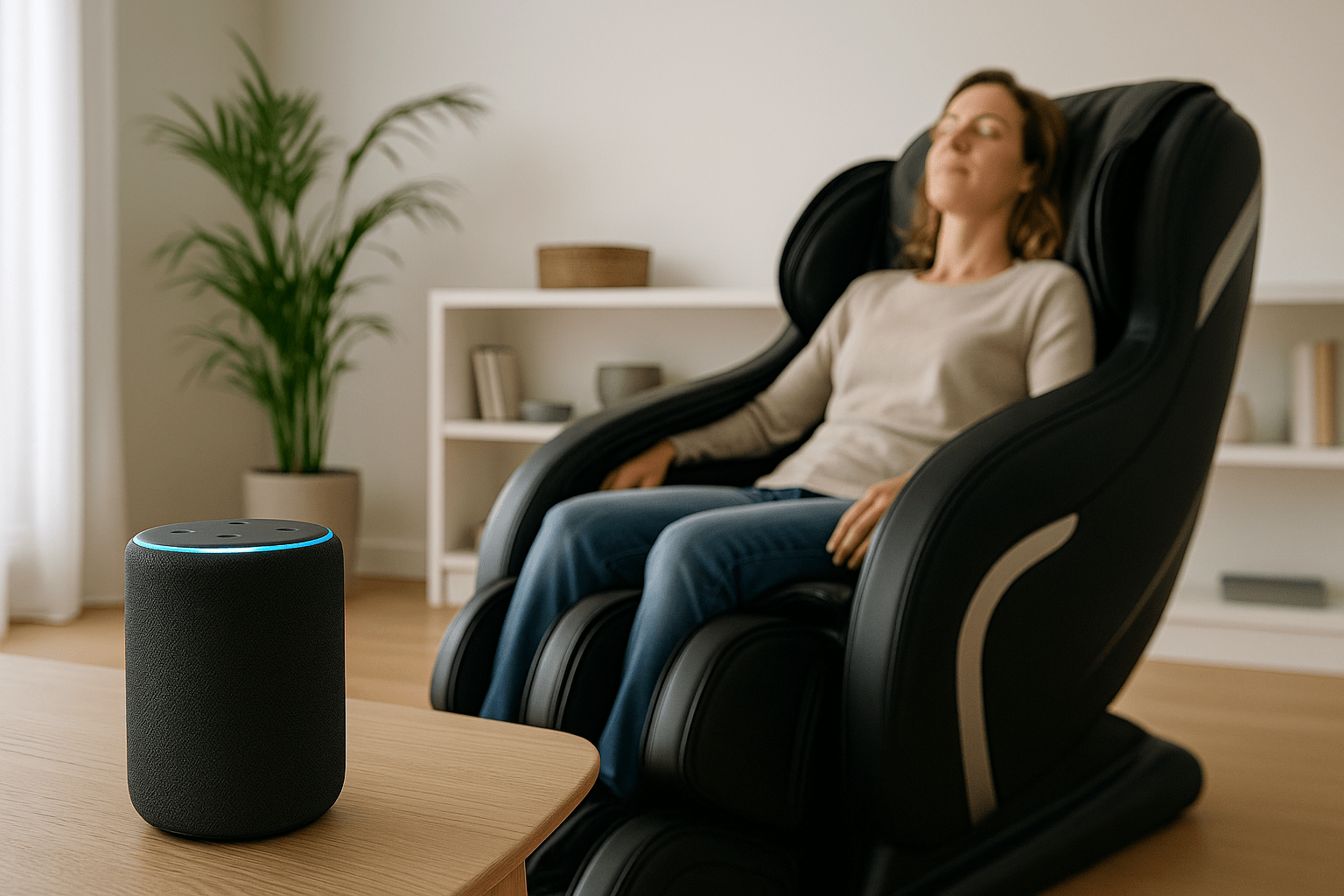
A high-quality massage chair, like this one MSW-300, offers much more than just vibrating or kneading. Modern devices work with multi-dimensional massage programs that use computer control to feel along the spine, record individual pressure points and simulate various techniques. These include Shiatsu, kneading massage, rolling massage or selective deep tissue massage.
The combination of mechanical pressure, rhythmic movement and optional heat therapy produces an effect that can be compared in many ways to that of a professional massage.
Especially for people with chronic tension in the lower back or a stressful everyday life, such armchairs offer a regular, low-threshold opportunity for relief, from the comfort of their own home, without having to wait or make an appointment. Studies on the specific effectiveness of massage chairs for lumbar spine pain are still limited [37], but initial results indicate that they can provide noticeable relief, especially when combined with exercise and active measures.
In addition to the physical effect on the muscles and fascia, the mental aspect also plays a role: the daily ritual of consciously taking time to relax, feel your body and find peace has a measurable effect on the autonomic nervous system. The change from tension to relaxation – physiologically speaking: from sympathetic to parasympathetic mode – can play a central role in regeneration. This is exactly where many armchair programs come into play.
In addition, modern models such as the MSW-300 are now also aesthetically pleasing, compact and can be easily integrated into living or working spaces. Thanks to different intensity levels, storable user profiles and often even voice control or app connection, the programs can be individually adapted. eA big advantage over standardized massage offers.
Of course, a massage chair does not replace a diagnosis by a medical professional or a holistic therapy. But it can be a powerful companion in everyday life, especially when it comes to preventing pain, regulating tension and doing something for your own long-term well-being.
Reading tip: Massage gun or massage chair – which is right for you?
Which exercises help with lumbar spine pain?
As obvious as it sounds, simply getting moving when you have back pain is often the best thing you can do. But many of those affected are unsure: What else can I do? What makes the pain worse? What really makes a difference?
The answer is pleasingly clear: Targeted exercise helps – provided it is correctly dosed and individually adapted. Studies show that people with lumbar spine pain respond particularly well to exercises that Mobilization, strengthening and stretching combine【30】【31】【32】. It's not about top sporting performance, but rather about gentle, conscious movements that stabilize the muscles, relieve tension and improve body awareness.
A tried and tested way to get started is with so-called Mobilization exercises, like that “Tilt the pelvis while lying down”. This gently moves the lumbar spine without putting any strain on it. The small movement impulses activate the deep back muscles and improve blood circulation - an ideal start for people with acute complaints or movement restrictions.
The one known from yoga is just as popular and effective “Cat-cow” movement on all fours. By alternating between a hunched back and a hollow back, the spine moves naturally. At the same time, those affected learn to actively connect with their back again. This exercise can also help relieve tension that often arises from static sitting.
Another important part of every back routine are Stretching exercises, like this Twisting stretch while lying down or the Hip and glute stretch, which is particularly helpful when pain radiates to the buttocks or legs. These exercises not only relieve tension in the lower back, but also have an effect on the Piriformis muscle, which is often involved in sciatica symptoms.
They are particularly effective – also preventative Strengthening exercises. This is about strengthening the deep abdominal and back muscles, which stabilize the lumbar spine like a corset. The “Bridge” (Glute Bridge) or that lateral forearm support (side plank) promote strength, body control and balance. Important factors to prevent back problems in the long term.
Also Support positions like the classic one plank can be useful, but in the case of acute symptoms they should only be practiced under supervision or in a weaker form.
One is recommended at the end of each unit relaxing posture like that “Child Pose”: a simple but effective resting position that gently stretches the lower back and calms breathing. Especially in conjunction with conscious, deep breathing, stress and inner tension can be relieved - an aspect that should not be underestimated in chronic pain.
What is important is: Not every exercise suits every back. In the event of acute herniated discs, numbness or severe pain, you should definitely seek medical advice beforehand. And the same applies elsewhere: quality over quantity. A few, consciously performed exercises often bring more results than many hectic movements.
For everyday life this means: A few minutes of exercise every day – as targeted as possible. Just three to five exercises a day can noticeably improve back health and be a sustainable way to stabilize the lumbar spine, relieve pain and regain confidence in your own body.
Reading tip: Here you will find illustrated instructions: Back training with the TK
Lifestyle: The underestimated factor
As much as we look for external causes of back pain - such as tension, disc damage or poor posture - we easily overlook a central influence: our lifestyle. It is precisely he who does it Health of the lumbar spine (lumbar spine) shapes us every day, for better or for worse.
Our lumbar spine is not a purely mechanical component that only suffers damage through physical stress. It is part of a finely regulated interaction Movement, regeneration, muscle tension and psychological balance. And it is precisely this system that is often thrown out of balance in everyday life. Not through individual missteps, but through them Sum of small, daily stresses.
This is a main factor Continuous sitting. Whether at a desk, in the car or on the couch – people in the 21st century sit more than ever before. But our backs are not designed to stay in one position for hours. The lumbar spine in particular suffers from this rigidity. The muscles relax, the intervertebral discs are no longer sufficiently “fed” through exercise, and the natural change between stress and relief does not occur. The result: muscle hardening, loss of mobility and long-term chronic pain.
It's just as damaging chronic stress out. In stressful phases, our nervous system switches to the so-called Sympathetic mode – Fight or flight. What promotes performance in the short term leads to increased muscle tension, shallow breathing, poor sleep and increased sensitivity to pain in the long term. Studies show that psychosocial factors such as stress, fear or exhaustion Significantly increase the risk of chronic back pain【12】【34】【36】.
Also that one Sleep, often underestimated, plays an essential role. The intervertebral discs regenerate at night, but only if sleep is sufficiently long and restful. Anyone who lies on a sagging mattress, sleeps restlessly or is constantly kept awake by back pain robs their body of valuable regeneration time.
The good thing: Many of these influences can be have a positive impact through small, conscious changes in everyday life. It's not about optimizing everything, but about regularly freeing the body from rigid patterns.
Already getting up regularly every 30 minutes, a short one Stretching the hips and back, dynamic sitting with changing positions or using a standing desk can help relieve the lumbar spine. Also conscious breathing, such as with one hand on the stomach, deep into the lower back, activates the parasympathetic nervous system and reduces muscular tension. In addition, one can healthy, anti-inflammatory diet (e.g. with omega-3 fatty acids, little sugar and enough fluids) can have a positive effect on pain.
Anyone who has extra time for... small breaks, gentle movement and maybe even a daily one Back unit in the massage chair treats, creates optimal conditions so that the body can heal and the back becomes the strong center it actually is in the long term.
When your head forgets your back, it hurts twice as much
Our brain is a powerhouse of thought processes, organization and decision-making. But that's exactly where the problem sometimes lies: we think so much and feel so little. Especially when it comes to your own body.
The lumbar spine is a silent carrier of everything we do: sitting, standing, walking, working, living. Only when it hurts do we realize how central its role is. It often sends signals early enough: small tensions, a pulling sensation, a stiffness in the morning. Anyone who learns to take these signals seriously can take countermeasures at an early stage with exercise, targeted exercises, conscious relief and relaxing measures such as massages or the intelligent support of a massage chair.
Lower back pain is not an inevitable fate. They are an invitation to pause, take responsibility and shape your own lifestyle more consciously. Not perfect, but with small, realistic steps. Because what people often forget is that a healthy back is not a sure-fire success, but it is an investment that pays off every day.
Do you want to do something good for your back? Then take a look at ours Massage chair for your health on – developed to relieve you every day.
⚠️ Important note
This article is not a substitute for medical diagnosis or treatment. If you have persistent or severe symptoms, please contact one doctorin or physiotherapist.
Related Articles & Resources
List of sources (ordered by reference numbers)
[1]
Non-surgical interventions for chronic back pain
https://sportaerztezeitung.com/sports-research/nicht-chirurgische-interventionen-bei-chronischen-rueckenschmerzen/
[2]
Low back pain: an overview of prevention and active treatment
https://www.physiotutors.com/de/rueckenschmerzen-uebersicht-zur-praevention-und-aktiven-behandlung/
[3]
Lifestyle changes to combat chronic back pain
https://physio.de/community/news/content/99/11313
[4]
Review article: Scoping review on manual therapies
https://www.thieme-connect.de/products/ejournals/pdf/10.1055/a-2607-8893.pdf
[5]
Anatomy & diseases of the spine
https://www.gelenk-klinik.de/wirbelsaeule/anatomie-und-erkrankungen-der-wirbelsaeule.html
[6]
Spine – DocCheck Flexikon
https://flexikon.doccheck.com/de/Wirbels%C3%A4ule
[7]
lumbar vertebra | Anatomy lexicon
https://www.gesundheit.de/lexika/anatomie-lexikon/skelett/lendenwirbel-id214624/
[8]
Lumbar spine syndrome: pain in the lower back
https://gelenk-klinik.de/wirbelsaeule/lws-schmerzen-lws-syndrom.html
[9]
Causes of back pain – The technicians
https://www.tk.de/techniker/gesundheit-foerdern/sport-und-bewegung/gesunder-ruecken/ursachen-von-rueckenschmerzen-2007860
[10]
Back pain – NetDoktor
https://www.netdoktor.de/symptome/rueckenschmerzen/
[11]
What helps against back pain? – Joint Clinic
https://gelenk-klinik.de/wirbelsaeule/was-hilft-gegen-rueckenschmerzen.html
[12]
The connection between back pain and psyche – Friedenweiler Clinic
https://www.klinik-friedenweiler.de/blog/die-verbindung-zwischen-rueckenschmerzen-und-der-psyche/
[13]
Lumbar spine syndrome – Johannesbad Medicine
https://www.johannesbad-medizin.com/orthopaedie/wirbelsaeulenerkrankungen/lws-syndrom
[14]
Call for back health – Therapiewerk Stuttgart
https://www.therapiewerk-praxis.de/post/aufruf-zur-pr%C3%A4vention-und-behandlung-von-r%C3%BCckenschmerzen-therapiewerk-stuttgart-west
[15]
Lumbar spine pain: causes & treatment – Liebscher & Bracht
https://www.liebscher-bracht.com/schmerzlexikon/lendenwirbelsaeule-schmerzen/
[16]
Lumbar disc herniations – University of Greifswald
http://www2.medizin.uni-greifswald.de/neuro_ch/index.php?id=419
[17]
Lumbar disc herniation – Joint Clinic
https://gelenk-klinik.de/wirbelsaeule/bandscheibenvorfall-lendenwirbelsaeule-lws.html
[18]
Lumbar disc herniation – Physio Baumann
https://www.physio-baumann.de/blog/bandscheibenvorfall-lws
[19]
Spinal canal stenosis, spondylolisthesis – Nuremberg Martha-Maria Clinic
https://kh-nuernberg.martha-maria.de/…/section-fuer-wickelsaeulenchirurgie/kranksbilder
[20]
Conservative back treatment – Medical Park
https://medicalpark.de/orthopaedische-reha/konservative-rueckenbehandlung/
[21]
Lumbar disc therapy – Krupp Hospital
https://www.krupp-krankenhaus.de/neurochirurgie/…/lumbale-bandscheibentherapie.html
[22]
Study on the effect of massage on chronic back pain – Fitreisen
https://www.fitreisen.de/studien/heilkuren/studie-zur-wirkung-von-massage-bei-chronischen-rueckenschmerzen/
[23]
Effectiveness of classic massage therapy – Springer Medicine
https://www.springermedizin.de/massage/rueckenschmerzen/wirksamkeit-klassischer-massagetherapie-bei-chronischen-rueckens/18393822
[24]
Classic massage and acupuncture for back pain (dissertation)
https://d-nb.info/1214443125/34
[25]
Effectiveness of Shiatsu – Vivabalance
https://vivabalance.ch/de/Shiatsu/Was-ist-Shiatsu/Wirksamkeit-Shiatsu
[26]
Review of the Shiatsu procedure – German health portal
https://www.ikt-institut.ch/…/forschungsstand-zur-effektigkeit-des-verfahrens-shiatsu…
[27]
Effects on Muscle Recovery in Athletes – PMC
https://pmc.ncbi.nlm.nih.gov/articles/PMC12140169/
[28]
Passive treatments for chronic back pain – gesundheitsinformation.de
https://www.gesundheitsinformation.de/passive-behandlungen-bei-chronischen-rueckenschmerzen-akupunktur-elektrotherapie-und-manuelle-therapien.html
[29]
Studies on massage – green masseurs
https://www.gruene-masseurinnen.at/category/studien/studien-massage/
[30]
Exercises for back pain – Thermacare
https://www.thermacare.de/schmerzen/rueckenschmerzen/was-tun/uebungen
[31]
Back training – TK
https://www.tk.de/techniker/gesundheit-foerdern/sport-und-bewegung/rueckentraining/rueckentraining-gelenkmobilisation-2008742
[32]
Lumbar disc herniation – online physiotherapy
https://www.online-physiotherapie.de/uebungen/ruecken/bandscheibenvorfall-lws/
[33]
15 back exercises – online physiotherapy
https://www.online-physiotherapie.de/uebungen/ruecken/rueckenuebungen/
[34]
Back pain – How to avoid chronicity – Brain Foundation
https://hirnstiftung.org/2025/03/rueckenschmerzen-so-vermeidet-man-dass-sie-chronisch-werden/
[35]
Sitting shortens life expectancy – AOK Magazine
https://www.aok.de/pp/gg/magazine/gesundheit-gesellschaft-02-2025/sitzen-verkuerzt-lebenserwartung/
[36]
Soul and back: Worries are often in the cross – stern.de
https://www.stern.de/gesundheit/ruecken/grundlagen/seele-und-ruecken-sorgen-sitzen-oft-im-kreuz-3564024.html
[37]
DRKS – German Register of Clinical Studies
https://drks.de/search/de/trial/DRKS00024848
Mitgründer und Geschäftsführer der Massagesessel Welt. Mit seinem Expertenwissen und seiner Branchenkenntnis hilft er, Privatpersonen und Unternehmen zu passenden Massagesessels für Entspannung, Gesundheit und Vitalität zu finden. Die individuelle Fachberatung erfolgt sowohl telefonisch oder per Videochat, als auch in der Ausstellung vor den Toren Stuttgarts.